Monday, 4 April 2016

"Merendanding" in Manchester

One of the things I enjoy doing the most is eating cakes, sweet things in general and drinking tea. For this very reason I like exploring my surroundings in search of nice cafés.

Costa
It doesn´t matter where you are in the UK, you´ll find hundreds of Starbucks, Costa and Café Nero in every street of every village, town and city of the country. I´m not saying they are bad options, but if you are looking for independent cafés or someplace unique, then probably these are not the cafés you want to walk in to.

Fortunately for us – people who love having a merienda (i.e. the Spanish word for the meal between lunch and dinner. Have you noticed I'm trying to introduce this wonderful word and concept of the merienda to the non-Spanish world?)-, we live in a time when Nordic-inspired-hipster-like cafés are trendy and in some areas, like the Northern Quarter in Manchester, there are as many as drunk people on a Friday night.

Today I´m bringing you 2 lists of nice cafés (I must admit I found most of them in search of free WiFi). They’re not rankings but just lists with no particular order of some of the cafés I´ve been to (also their address and twitter) and my personal opinion on them based solely on my experience there. I promise I´ll keep on researching and bringing more lists to you in the future.


Some nice cafés in Stockport:


The Funky Monkey Coffee Company
175-177 Bramhall Ln
@FunkyMonkeyCC

For me, the Funky Monkey is an institution, it´s the centre of Davenport. If you want to know what´s going on in that area of Stockport, go to the Funky Monkey. I love how people of all ages go there and everybody knows each other. The staff is incredibly nice and the food is gorgeous. Try the mango smoothie, delicious!


Tandem Coffee House
47 Lower Hillgate
@TandemCoffeeSK1

I´ve only been to this café in the early morning because they close at 3pm which is a bit early for a merienda. The breakfasts I´ve had there have been absolutely beautiful. Besides, when my teapot got cold, they replaced it for a hot one so I could keep on drinking tea till the end of time. This is a theme café, the theme is bikes and cycling so the decoration makes this café very unique. Also, it´s very quiet due to its location.


After Eight hot chocolate

Cafelito
59 St Petersgate
@CafelitoCoffee

If you like mint chocolate, you will adore the After Eight hot chocolate here. I do. This is a big café and for some reason I don´t know (yet), they often have Spanish food and not only serve it in the café but also at the Foodie Friday events at the Stockport Market. I’ll keep on investigating.


cinnamon waffle + house blend tea
Rhode Island Coffee
2 Little Underbank
@RhodeIslandCoff


This is a big and beautiful café. I especially like seating in the large sofa next to the window in the upper floor. I used to go a lot to this café to use their WiFi to Skype with my family, and also to treat myself every now and then. My favourite is the cinnamon waffle with a cup of the house blend tea.


Jaffa-cake cake + carrot cake
Huffys
30 Great Underbank
@HuffysBar

I´m not sure what is prettier in this café, the inside or the outside? Whatever the case, this place is perfect for a late merienda because they close quite late since it is also a restaurant. The cake and hot drink deal is fantastic here. Try the Jaffa-cake cake or the carrot cake, they´re simply superb.


French toasts with Nutella and strawberries + brownie
Rosie’s coffee house and kitchen
95 Prince´s st
facebook.com/Rosiescoffeehouse

This place opened quite recently but it is already a classic. The decoration is simple and delicate; just perfect. And the food is good quality. Besides my sweet treat, I also had the eggs benedict and they were delicious. They also have a wide selection of drinks but I can´t tell you much about them because I always go for the Moroccan tea.


Some nice cafés in Manchester:


North Tea Power
36 Tib st
@northteapower

I feel a special connection to this place because it’s the first café I went to in Manchester. When I had my first job interview, even though I didn’t get the job, I had been so nervous that I wanted to treat myself for having survived the interview. I walked into this café and… what a glad surprise! They had Oolong tea! It´s a nice place but at certain times can get too busy so if you´re looking for a place where you can chill, maybe this is not always the best place to go.


cream tea
Café at the Ryland
150 Deansgate
@TheJohnRylands

This is not exactly a beautiful café BUT it´s inside the John Ryland’s library, which is beautiful enough to compensate the looks of the café. It’s closed quite early because the library closes at 4 and, ironically, it can be quite noisy, especially if you are expecting it to be as quiet as the library itself.


Proper Tea
10 Cateaton st
@propertearooms

This is one of the most beautiful cafés tearooms in the list. The decoration of the place is exquisite and the views to the cathedral make it even prettier. The tea here, as the name of the tearoom implies, is proper tea. It´s served with a timer, and you have to serve it onto a different teapot before serving it into the cup. Don´t worry if you don´t know what to do, the staff will take care of explaining it to you in detail. It can be quite pricey, to be honest, but it´s definitely worth it. Just for fun, try to find the toilets and go back to the tearoom without getting lost at least once.


Ziferblat
23 Edge st
@ZiferblatEdgeSt

This is a VERY unique café. The quality of the products is not exactly like that of the other cafés in the list, so if you’re looking for high quality, this is not your place. The interesting thing about Ziferblat is the concept: you don´t pay for what you eat/drink, but for the minutes you spend there. First of all, you need to find the café, which is not very easy if you haven´t been there before. You access it through a lift, so it seems you’re going to an office instead of a café. But once you walk in, you can´t help but to be impressed by how big and beautiful the place is. Once you register the time of your arrival at the counter next to the entrance, YOU make whatever you want to drink: there’s a kitchen with all the products and utensils you might need. Also, there’s a piano you can play if you want, books you can take and read, board games, etc. When you are finished, before leaving, you must take your cups and plates to the kitchen and either wash them or put them in the washing machine. Then you tell the boy at the counter your name, and he’ll tell you how much you have to pay for the minutes you’ve been there. Best of all: it’s very cheap. I’m afraid I don’t have any photos of this place.


chocolate + banana + peanut butter + salted caramel milkshake
Black Milk Cereal Dive
52 Church st (Affleck’s Palace, 2nd floor)
@blackmilkcereal

This café is in a tiny corner at the Affleck’s Palace and has had an amazing success in a very short period of time. I found out about them, funny enough, because they followed me on Twitter. They specialise in cereal. They have lots of different types of cereals, sometimes from around the world, sometimes special editions. You can mix different types in a bowl with milk or flavoured milk. You can even order it in an edible bowl – there are 3 different edible bowls: dark chocolate, milk chocolate and white chocolate.  Just let your imagination decide what to put in the bowl or the jar and give it a try. As I said, they’ve had such a success that they’re extending the café and making it bigger.


the best banoffee cupcake ever
Hey Little Cupcake!
Little Quay st
@HLCupcake

I found out about this café cupcakery when I won one of their cupcakes for retweeting something in Twitter. I’ve only been there the time I went to collect the cupcake I had won. The place looked beautiful and I was impressed by the fact that they organise classes where you can learn to make your own cupcakes. The cupcake I won was not a specific one, I could choose one from a selection. I chose the banoffee one. I’m not exaggerating: it was the best cupcake I have ever had. My next sweet goal is to try the afternoon tea there.


Pot Kettle Black

14 Barton Arcade, Deansgate
@PKBcoffee

This café is in the stunning Barton Arcade. Every time I have to go from Market st to Deansgate, I try to go through the Barton Arcade (unless I have to go to Paperchase, of course) because if the Titanic was a building, it would be something like this. I’ve only been to this café once but it’s so pretty and comfortable, and the staff is so kind, I’m definitely going back. I had a pot of Darjeeling tea and it was served with a thin wafer tube. More than correct.


Ibérica Spinningfields
14-15 The Avenue
@IbericaMCR

This one is not a café, it´s a restaurant, a very good one, actually. Ibérica is a chain of restaurants that belong to Spanish chef Nacho Manzano, who has 3 Michelin Stars, so yes, food in this restaurant is of the finest quality but, at the same time, it’s not as expensive as one would expect. Anyway, today I’m not talking about that (maybe in another post I will talk about restaurants). Today I’m only focusing on what I had for desert: a chocolate mousse with berries, which was from out of this planet. Although this desert is quite international, in this restaurant they offer a selection of typical deserts from around Spain. If you want to get a glimpse of typical Spanish deserts, try going to this restaurant.


I think 14 are more than enough for my first post about nice cafés in the Greater Manchester. Have you been to any of these? What is your opinion about them? Have you been to any other café in Manchester or Stockport? As usual, all comments are welcome and appreciated. Thanks for reading!

Monday, 29 February 2016

Let me recommend you a book and... come fly with me!

Today I’d like to introduce to you one of my favourite books ever. This is not one of the best ones I’ve ever read but it means a lot to me. My father gave me this book when I was about 15 years old and I’ve loved it ever since. It opened a whole universe where to escape to in those strange teen years. The book is The Dictionary of Imaginary Places by Alberto Manguel and Gianni Guadalupi. 

The title of the book is pretty self-explanatory: it is a dictionary of imaginary places. Just as a dictionary has a number of entries in alphabetical order with a definition of that entry, this Dictionary contains a long list of places and a description of the place, the people living there (in case somebody lives there), how to get there, the costumes, the traditions, maps, etc., any information that can be retrieved from the sources. Let me explain.

The authors of the Dictionary, Gianni Guadalupi (an Italian historian who has written, mainly, books about travelling and exploring) and Alberto Manguel (a Canadian-Argentinian editor, novelist, essayist, anthologist, translator and author of many non-fiction books) explain in the beautiful foreword why they decided to write this book: one afternoon in 1977, Guadalupi proposed Manguel to write a travel guide for the explorer who wants to visit the ancient (and imaginary) city of Selene, invented by Paul Féval in his novel La Ville Vampire. This idea developed into creating a guide for the explorers interested in other imaginary places. It took them years to gather a list of places and all the existing information about them. The first edition was published in 1980, followed by an extended second edition published in 1987, and an even more extended third edition in 1999 (the version I have, translated into Spanish). 


At the end of every description - which is addressed to the explorer, just as if it was a real travel guide, - you can read the name of the creator of that place, the name of all the books you can find that place in, and where/when those books were published (see the photos Leonia vs Leuké). 
Leonia


Leuké

Also, at the end of the book, there is an index of all the places mentioned in the Dictionary classified by their authors, so you can easily find authors such as
 Hans Christian Andersen, Sir James Matthew Barrie, L. Frank Baum, Gustavo Adolfo Bécquer, Jorge Luis Borges, Charlotte Brontë, John Bunyan, Edgar Rice Burroughs, Étienne Cabet, Italo Calvino, Lewis Carroll, Chrétien de Troyes, to mention just a few.


I loved this book when I was a teen because I love travelling; I think I’ve always done so. As a little girl, I would take an atlas and spend hours looking at the maps. But after some time, the world was not big enough and I needed a bigger universe to explore, and this Dictionary was the perfect solution because it gave me a glimpse of all this imaginary places I could visit.

I really hope there is going to be a new extended edition because in the last one, and just to mention a few examples, not a single place imagined by G.R.R. Martin can be found (even though A Game of Thrones was published in 1996 and A Clash of Kings in 1998), and having a detailed description of Westeros and Essos would be absolutely wonderful.  Anselm Audley’s Aquasilva Trilogy - Heresy (2001), Inquisition (2002) and Crusade (2003) – is obviously not included in the Dictionary either; and from all of J.K. Rowling’s imagined places, only Hogwarts and the Forbidden Forest are included, while I’d personally love to read about Hogsmeade, Diagon Alley or the Ministry of Magic as well. 


What about you? Have you read this book? If not, would you like to? What are your favourite imaginary places? Thanks for reading! And remember: Leave a comment and share!

Monday, 22 February 2016

10 sci-fi films you need to see... or not.

Dear all, let me apologise, first of all, for not posting in such a long time. In all these months I’ve had lots of ideas but I couldn’t find the will to sit down and write. Fortunately for me and thus for you, in the last month two things happened that pushed me into writing again.

The first thing was attending the presentation of the book Para vos nací. Un mes con Teresa de Jesús by Spanish writer Espido Freire. Everything Miss Freire explained about 16th century’s Spanish writer Teresa de Jesús was so vivid, appealing, interesting, and from such a modern point of view that I felt like she was speaking for and about me. It stirred my emotions and desires so much, that after the conference I approached her and told her: “you’ve made me want to write again”.

The second thing was meeting one of my favourite bloggers/youtubers (not that I follow many, to be fair): La sombra de Nikky Udall, and a friend of hers - now also a friend of mine -  known as Miss Keats. We spent hours talking about books, films, series and so on. When you do that with someone who enjoys those little pleasures even more than yourself, makes you a bit jealous in a good way; and in my case, made me want to definitely bring this blog out of the coma.

So here I am bringing you an update of my old post about films that revolve around the themes of time travel, parallel universes, dystopias, etc. This time, the list is shorter, only 10 films. As usual, I’m giving you a few details about each film but spoiler-free. I hope you find it useful and remember: any comments, suggestions, questions, and/or opinions are very welcome and appreciated, so feel free to post your comment in the box below.


Mr. Nobody (2009)
This is a good film (with a superb Jared Leto leading the cast) but not easy to follow. Nemo Nobody is the last mortal on earth who, before dying, explains his life story to a journalist. However, what he explains is not 1 but 3 different lives. The key to understanding the film is revealed very little by little, mostly in the last 5 minutes. If you have seen Run, Lola, run, you understand what it is about straight away, but if you haven’t... may God have mercy on you, because the scriptwriter didn’t have any. The only thing he did to help you out is to have this poor journalist asking questions who, unfortunately, doesn’t get any straight answer.

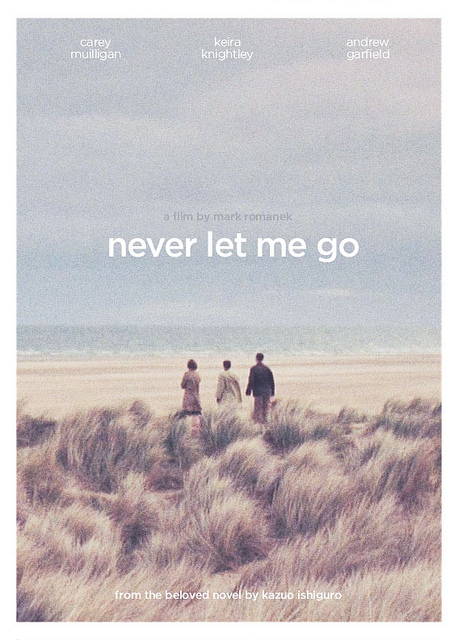
Never let me go (2010)
Based on Kazuo Ishiguro’s novel, it couldn’t be a bad film, and certainly it doesn’t disappoint. The film follows the life of a girl called Kathy H and her friends Tommy and Ruth while they all live in a British boarding school during the 70s, and also when they leave the school and go to a farm house to live in cottages during the 80s. I’m afraid that if I explain more about the plot, I’ll be spoiling the fun so you’ll have to trust me: although it may seem a bit slow, it’s worth watching. When I first saw this film I thought I was watching some sort of romantic drama… but I couldn’t be any more wrong. Give it a try!

Safety not guaranteed (2012)
This is a film I categorize as one of those “cute little films”: low budget, no special effects AND with that wonderful indie humorous touch. The film is based on a classified ad that John Silveira wrote as a joke in Backwoods Home Magazine that reads as follows:
WANTED: Somebody to go back in time with me. This is not a joke. P.O. Box 322, Oakview, CA 93022. You’ll get paid after we get back. Must bring your own weapons. Safety not guaranteed. I have only done this once before.
The film is about 3 journalists working for a magazine that are sent to find out who wrote this ad and why. It’s a beautiful little story about characters rather than time travelling itself.

Extracted (2012)
[Known as Extraction in the UK] I watched this film without knowing absolutely anything about it, and I think this is exactly how you want to watch it. It’s one of those really good films that very few people have seen because there are no important actors in it, or because the publicity campaign was tiny. If you don’t care about spoilers, proceed: Tom is a scientist who has invented a machine capable of retrieving a person’s subconscious memories. His objective is to use it in people who suffer from amnesia but he is put under pressure to accept money from an anonymous investor who wants to try the machine before it has been proven to be 100% safe. The investor happens to be an official who wants to use the machine to find if an addict called Anthony really killed his girlfriend, as suspected. When Tom enters Anthony’s mind, something goes wrong and he gets trapped there.

Snowpiercer (2013)
I love this film. In my opinion, it is the best film in this list. Snowpiercer is a South Korean film (filmed mostly in English) based on the French graphic novel Transperceneige. It stars a fantastic Chris Evans (I was gladly surprised by his interpretation), Jamie Bell, John Hurt and an unrecognisable Tilda Swinton. As with Extracted, I watched it knowing nothing about its plot, which made the experience more enjoyable and I recommend you to do the same, but if you don’t want to listen to me, read ahead: Set in a post-apocalyptic frozen planet earth, the only surviving humans live on a train called the Snowpiercer, which travels around the planet without stopping and is the only place where a human can live without freezing to death in a few seconds. The main character, Curtis Everett, lives along with other people in the tail section, the section for low-class humans. They know that the closest to the front of the train, the higher the class of the humans living in it and the better the conditions they live in; so Curtis decides to start a revolution to get to the front of the train. The beginning is intense but it gets more and more intense as the film goes on.

Oblivion (2013)
Joseph Kosinski wrote a graphic novel called Oblivion about a post-apocalyptic planet earth destroyed by aliens. It never got published so he decided to make a film. He is really good at making computer graphics and CGI, and you can tell in the film that its makers really care about making good visuals. The problem with this film is the plot. The plot is rubbish. Kosinski and his mates were too ambitious and they failed. If you are a person who goes to the cinema mainly for the visual effects, watch this film because it is visually stunning. But if you care about a good script, go watch something else. I don’t even care about explaining what the film is about.

Project Almanac (2014)
Primer + Jackass = Project Almanac. This film is produced by the MTV, and they made sure there was a lot of music in it without any logical reason why. Jonny Weston (27 when the film was shot) plays a super intelligent 15 year old boy in a high school who, along with two losers friends, builds a time machine and uses it for… everything an American teenager would use it for.
MTV hasn’t done anything good since Daria.

Edge of tomorrow (2014)
Source Code with Tom Cruise + chicken-aliens + an ending à la Jerry Bruckheimer = Edge of tomorrow. The starting idea is interesting because it is based on Hiroshi Sakurazaka’s novel All you need is kill, but since the film was “Americanised” it ended up being two hours of Tom Cruise showing off. The film is set in the future, when the earth has been invaded by aliens and human armies are fighting to survive and kill these aliens. Bill Cage is an officer, with no combat experience, who is sent to an operation and killed in combat. However, he wakes up and finds out he is in a one-day time loop. He also finds he is not the only one with this ability. Fantastic starting idea, wrongly developed.

Lucy (2014)
If you like this film, please don’t kill me just because I don’t. If you watched /will watch it because it stars Scarlett Johanson, good for you. I watched it because Luc Besson is the director and I was very disappointed. This is the idea: a woman is tricked into working as a drug-mule. She carries the drug in her abdomen but when one of her captors kicks her stomach, the drug is released and gets into her system causing her brain to use more of its capacity, developing abilities in her like telekinesis, super-strength, etc. It sounds really cool, and believe me, it is… but that ending… dear me… I don’t want to spoil you but it’s the most deceiving thing ever.

Transcendence (2014)
Christopher Nolan was the executive producer of this film, and that’s enough to make me want to see it. But… I can’t really tell what I disliked the most about this film. It has Cillian Murphy and Paul Bettany in it, which makes it good straightaway but I´m not sure whether Johnny Depp interprets or not. It seems like he was bored or he didn’t want to be there. It’s so bad, I’m not even going to explain what it is about because I don’t want you to watch it.


So these are the 10 films of the list. Have you seen any of them? What is your opinion? Do you agree with me or not? Are there any other films you want to recommend? Leave a comment.

Monday, 11 May 2015

Don't go to Barcelona. Thank you.

Les Rambles are amazing

“Where are you from?”
“Barcelona”
“Oh, I love Barcelona!”
“Have you been there?”
“Yes! I loved Les Rambles!”

I’ve had this conversation with around 100 people in my whole life, and I’m sure I will have it many more. Every time I have it, between 32 and 2975 of my brain cells die.


There's a lot to do in Barcelona in August

As a child and as a teenager I was not aware of the fact that I was from Barcelona. I went through a phase of hating the city (and I don’t mean the way all Barcelonians feel in August when there’s absolutely nothing to do there, I mean really hating Barcelona: I didn’t find any beauty in so many buildings and so much pollution). And then, after I lived away for a while and went back, I started loving Barcelona. And that love has kept growing deeper and deeper. So when people tell me they “loved Les Rambles”, they don’t understand why I want to punch them in the face straight away. The reason is because I know Barcelona, it’s mine… just as it also belongs to every other person who lives in Barcelona. We all have our own personal Barcelona.


I read an article some time ago in traveler.es called “46 things you’ll only understand if you’re from Barcelona”. It’s one of those articles with a list of funny things that I usually disagree with. I was surprised, though, that I agreed with most of the points in the list, and I actually found it hilarious. So in this post I’m going to explain some of those points (I’ve reduced it to 10) and add my opinion. If you are thinking of visiting Barcelona, this may help you understand a few more things about the city and the locals.


1. The right way of saying “bye” is “adéu”.

Forget about “adiós”, that may work in the rest of Spain (maybe not the Basque Country), but definitely not in Catalonia or its capital city, Barcelona. It doesn’t matter if you’re originally from Madrid, Sevilla, Moscow or Tokyo, if you live in Barcelona, you say “adéu”. Actually, we don’t even pronounce the “a”, we say “déu”.

2. We love complaining about tourists. 

Absolutely true. We don’t go where they are: Les Rambles, the Sagrada Familia (like most Barcelonians, I’ve never been inside. The ticket is 16€ for goodness sake!!!), or the Park Güell (I have the card that allows me to access the park for free… and I’ve never used it). It's not the tourists' fault, we know, it's actually the government's who has found a goldmine there and doesn't have any control over the hordes of tourists that invade Barcelona every day. If you are really interested in knowing more about this problem, there's an incredibly fantastic documentary called "BYE BYE BARCELONA" which explains this in more detail.


3. Walking down Les Rambles is a nightmare.

Poor tourists, they think the restaurants there serve decent food at reasonable prices. WRONG. And then they all get drunk in a second and the Rambles are full of drunk tourists vomiting everywhere and trying to find more bars where to drink more: they may go down the Rambles and end up in the port, or up the Rambles and then they invade the George Payne (a really cool Irish pub… or at least, that’s what it used to be) in Plaça Urquinaona. A tourist from New Jersey once started shouting at me there, she was drunk and I thought she was going to kill me. Then she hugged me and wanted to be my best friend. Tourists.


4. It’s easy to find your way.

Barcelona is like a square: the sea on one side, the mountains in the other, and rivers in the other two, the Besos and the Llobregat. As long as you know that, you know how to give directions and to find your way. If you don’t is because you’re not from Barcelona or you don’t have Google Maps.


5. Each neighbourhood used to be a town in the past. 
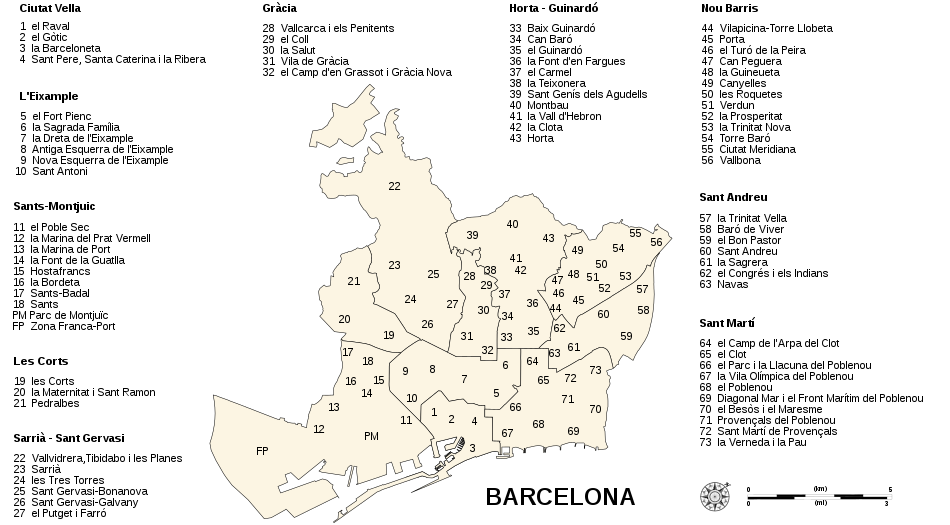
These are all the districts and neighbourhoods of Barcelona
Sants, Sarrià, Gràcia and all the others… each one is different. Different architecture, different history, the people living in them are different as well. Each neighbourhood has its own festival that usually lasts a week, with free concerts, competitions and activities for everyone. The best festival is supposed to be the one in Gràcia (around the 15th of August) but I’m probably saying so because I’m from Gràcia.


6. Of course there are beaches in Barcelona, but we don’t go there. 
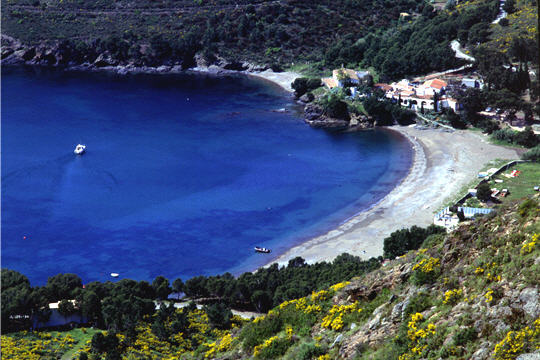
Cala Montjoi
(rocky coves in the north)

If we want to go to the beach, we go to the north or to the south, it depends on what kind of beach we like going to. The beaches in Barcelona are dirty, so we leave them to the tourists and their shadows: the thieves.
Castelldefels
(long sandy beaches in the south)

7. Barcelona is VERY humid. 

Cold feels colder and heat feels hotter because of humidity. You feel your bones wet in the winter, and in the summer… you can’t sleep. We don’t like our weather, but we feel sorry for yours anyway.


8. Food and mealtimes are SACRED. 
Shut your mouth and eat your food!

We don’t skip meals and each meal must have at least 2 courses. Lunchtime can last from 2pm to 5pm in the weekends. Dinner never happens before 9pm. Don’t be surprised at this if your dinner time is at 6 or 7pm, confess it: you are hungry again by 11pm. By the way, tapas is not a type of food, is a way of serving food. And it’s more of a way of socializing than eating. If you understand the concept of “pub-crawling”, then you understand the concept of “tapear”, it’s exactly the same but sharing food with your mates in tiny dishes. Do you know when you are in a pub and you ask the waiter to bring some peanuts? Well, that’s a tapa. Mindblowing, eh?


9. We don’t drink or take coffee, we “do” coffee.

When we want to meet up with a friend at any time before dinner, we use the expression “meet up to do a coffee”. It doesn’t matter if it’s in a café or at my/his/her house. In fact, it doesn’t matter if you really have a coffee or not.


10. We like to think we made everything first, and that what we do becomes trendy.

People in Barcelona have a sense of fashion not according to any trend but to each individual. It doesn’t really matter what you wear, as long as you do it in the right place. Each type of personality has its place in Barcelona. If you’re a goth, your street is Tallers (especially since they shut the Valhalla, a bar for rockers). If you are a skater, go to the MACBA. If your style is steampunk or Victorian goth, you’ll find a lot of people like you in Arc de Triomf, though you may also find other kinds of geeks and nerds there because the Gigamesh bookstore and the Norma Comics store are there. Bohemians and artists are in Gràcia. Hipsters go to Sant Antoni, to all these new bars and restaurants where they serve homemade beer and vermouth. Posh people are found in Bonanova and Sarrià, and chavs in El Carmel or racing with their cars in La Rabassada. The list is neverending.


I could go on and on talking about Barcelona but I’ll leave it here. If you are from Barcelona and want to add anything, feel free to post a comment. If you are not from Barcelona but you’ve been there, you’re comments are very welcome too. And if you aren’t from and haven’t been to Barcelona and want to ask or say anything, go ahead.


(All the gifs used in this post are taken from the tumblr account "When you live in Barcelona", run by a British person who has lived in Barcelona for years. Really worth having a look.)

Tuesday, 5 May 2015

"You right, love?" A linguistics nerd in Manchester

“Grammar is the greatest joy in life, don’t you find?” says Auntie Josephine in Lemony Snicket’s A Series of Unfortunate Events: The Wide Window. Grammar may not be exactly what you consider a joy. I certainly do not. But I can’t help loving phonetics and phonology with all my heart. Call me a freak.

I moved to Manchester around 10 months ago. My oral comprehension has never been very good - not even in my mother tongue -, so getting used to the Mancunian accent took me a while. Once I got used to it… or sort of, I started mentally making patterns of this accent’s features that were unusual to me. I’m sure there are lots of studies on the Mancunian accent, but here’s a list of just a few of the features I’ve personally noticed:


Intrusive /r/

10 years ago I was in my 2nd year in university and studied English phonetics and phonology for the first time. In those lessons I heard about the phonetic phenomena called linking /r/ and epenthetic or intrusive /r/.  Let me explain what these are:

In RP (RP is considered the standard variety of British English; also called the Queen’s English or BBC English), the final /r/ in words ending in vowel + /r/ is not pronounced.

e.g.:       “car” /kɑ:/
                “waiter” /’weɪtə/
                “fire” /’faɪə/

However, if these words are followed by a word beginning with a vowel, this /r/ that had disappeared is now pronounced. This is called linking /r/.

e.g.:       “car and bike” /’kɑrən’baɪk/

Notice that this linking /r/ only happens between vowels. A development of this rule is the so called epenthetic or intrusive /r/. This intrusive /r/ will appear between vowels even in cases where the first word does not have any /r/ in it.

e.g.        “law” /lɔ:/ -- “law of a country” /’lɔrəvə’kaʊntrɪ/
                “draw” /drɔ:/ -- “draw a map” /’drɔrə’mæp/

Being the Mancunian accent a British one and thus a non-rhotic one, I expected to hear this linking /r/ all the time. And I did. But what I did not know is that I was going to hear the intrusive /r/ as well… even in the middle of words (which means that this rule applies not only to word endings but to any open syllabic codas) and in isolated words (which… is absolutely crazy)!!!

e.g.:       “drawing” -- RP /’drɔ:wɪŋ/ vs Manchester /’drɔ:rɪŋ/
                “idea” -- RP /ʌɪ’di:ə/ vs Manchester /ʌɪ’di:ər/


Final velar nasal /ŋ/

I was an EFL teacher in Spain for some years and, as I’m sure you’ve already noticed, for me, right pronunciation has always been a matter of concern. One of the hardest things for Spanish students is correctly pronouncing the final velar nasal, as they assume the <g> must be pronounced. They either add a velar plosive (usually a voiceless one as in Spanish there is no final voiced velar plosive) or they change the velar nasal for an alveolar nasal.

e.g.:       “eating”          RP /’i:tɪŋ/
                                               Spanish students      Option 1: /’itiŋk/
                                                                                              Option 2: /’itin/

But then I arrived to Manchester and my world was turn upside down:

RP <ng>  [ŋ] / __#
Manchester <ng>  [g˳] /__ #

So to make Spanish students happy, here the <g> is pronounced and actually, it’s slightly devoiced. “Eating” would be pronounced as /’i:tɪŋg˳/


/u:/ fronting

I’ve noticed that in some words with what in RP would be the /u:/ sound, here is pronounced /y:/. It’s like a 21st century Vowel Umlaut. I’ve heard it in final position in monosyllabic words (e.g.: “poo” - RP /pu:/ vs Manchester /py:/) but I’m still trying to figure out if this is the only condition in which this fronting occurs.


Glottal fricative dropping

For some reason, in most cases, Mancunians drop the glottal fricative when it’s at the beginning of a syllable, and especially if this syllable is unstressed.

RP [h] vs  Manchester Ø / #__Vͯ

e.g.: “tell him” [‘telɪm]

When I think of how the names of certain places in England are pronounced, I assume the glottal fricative dropping is an extended feature.

                e.g.:       “Buckingham” /’bʌkɪŋəm/
                               “Dunham” /’dʊnəm/
                               “Birmingham” /’bɜ:mɪŋəm/

I realise these 3 examples I’ve given contain the same ending ( <-ham> ) which derives from the Anglo-Saxon word “ham” meaning "settlement", so maybe my theory that the glottal fricative dropping is a widespread feature is completely wrong.


Last but not least, I’d like to mention one of my favourite cases. It’s a mix of the first and the fourth features listed: intrusive /r/ and glottal fricative dropping.

It’s the way the phrase “saw her” is pronounced. The /h/ in “her” disappears, which results in a diphthong. This diphthong is then broken by introducing /r/.

                RP [‘sɔ:hə]
                Manchester [‘sɔ:ɽə]


Absolutely lovely, don’t you find?