Showing posts with label books. Show all posts

Tuesday, 14 June 2016

Today's little book haul

I'm going to assume you're interested in knowing that today I bought 3 books at a little book fair at my workplace.

The first one is Harper Lee's To Kill a Mockingbird. 

I know it's a classic and that's already a good reason for me to buy it.
However, even though it's a classic, I've absolutely no idea what it is about. And I LOVE that. Virgin reader.


The second one is Thomas Hardy's Far From The Madding Crowd.

Being completely honest, I had never heard of this book until I saw the ads of the film starring Carey Mulligan. I haven't seen the film and, again, I don't know much about the book. I can't wait to start reading it.


The third one is Rick Yancey's The 5th Wave. 

It looks like another post-apocalyptic young adult novel, and it has Chloe Moretz in the cover, what else could I possibly want? I had to buy it, I had no other option.
Problem: after buying it I realised it's the first book of a trilogy, which means if I like this one I'll have to spend more money.


Have you bought any books recently? Leave your comments!

Wednesday, 1 June 2016

Quick thoughts: THE HOST


Today I finished reading The Host by Stephenie Meyer and I want to share with you a few things.

This is not a review of the book or an in-depth opinion but it will probably contain spoilers so if you haven't read this book (and you want to), you might as well stop reading this right now.

Before I start, I want to make sure that you don't think I only read YA (Young Adult) novels. I'm always reading more than one book at a time but YA novels are very catchy, easy and quick to read so I always finish them first.

And now, let's go!

1. I never thought I'd read any other book by S. Meyer again. But a friend gave this one to me and I gave it a try. I don't regret reading it.

2. I must admit, though, it took me a couple of chapters to understand what was going on.

3. I don't know who said it wasn't, but this novel IS a YA novel.

4. The novel has about 600 pages, and there are only 3 action scenes. Taking into account that this novel is about aliens invading the Earth, you would expect some more action. But it's fine for me, I don't like too much action in a romantic YA novel and actually this lack of action scenes does work pretty well.

5. I know there's a film based on this book but I haven't seen it. Thinking of how angry I usually get at the poor adaptations of YA novels, and having seen the trailer... I've decided I don't want to see the film, for my own sanity.

6. Maybe it's a bit early to say that Meyer's formula of the love triangle is becoming a sort of trademark of hers. But I can't help comparing this love triangle to the one in her earlier saga: 2 boys (Darcy-like vs Heathcliff-like: Ian vs Jared in this particular case) fighting over the same girl. She's in love with both of them. Well, sort of. She ends up with Darcy. Of course. But Heathcliff won't be left alone because that wouldn't be fair.
In The Host, there are two girls but they share the same body so it adds more confusion to this love mess.

7. What's all about those lame names the aliens use to call their medicines and themselves? It's like a 3-year-old had named them!

8. Meyer is still good at giving different voices to her characters. You can easily tell whether it is Mel or Wanda speaking.

9. I don't really like this constant idea of Meyer's about being in love with 2 people at the same time, playing with their feelings, and choosing just one in the end. These are books and she compensates that by giving a new lover to the one that's left alone so everyone has a happy ending, but I'm worried teenage girls will do this to boys expecting it to be totally fine.

10. I didn't like the idea that the body chosen for Wanda at the end of the story is a little blonde, blue-eyed girl because "she looks like an angel and that's what Wanda kind of is as well". Wanda is fantastic, I agree. But why using this stereotype of the good person having to be pale, blonde and blue-eyed?

Have you read this novel? Do you agree with my opinions? Do you have any other opinion you'd like to share? All comments are very welcome!

Monday, 29 February 2016

Let me recommend you a book and... come fly with me!

Today I’d like to introduce to you one of my favourite books ever. This is not one of the best ones I’ve ever read but it means a lot to me. My father gave me this book when I was about 15 years old and I’ve loved it ever since. It opened a whole universe where to escape to in those strange teen years. The book is The Dictionary of Imaginary Places by Alberto Manguel and Gianni Guadalupi. 

The title of the book is pretty self-explanatory: it is a dictionary of imaginary places. Just as a dictionary has a number of entries in alphabetical order with a definition of that entry, this Dictionary contains a long list of places and a description of the place, the people living there (in case somebody lives there), how to get there, the costumes, the traditions, maps, etc., any information that can be retrieved from the sources. Let me explain.

The authors of the Dictionary, Gianni Guadalupi (an Italian historian who has written, mainly, books about travelling and exploring) and Alberto Manguel (a Canadian-Argentinian editor, novelist, essayist, anthologist, translator and author of many non-fiction books) explain in the beautiful foreword why they decided to write this book: one afternoon in 1977, Guadalupi proposed Manguel to write a travel guide for the explorer who wants to visit the ancient (and imaginary) city of Selene, invented by Paul Féval in his novel La Ville Vampire. This idea developed into creating a guide for the explorers interested in other imaginary places. It took them years to gather a list of places and all the existing information about them. The first edition was published in 1980, followed by an extended second edition published in 1987, and an even more extended third edition in 1999 (the version I have, translated into Spanish). 


At the end of every description - which is addressed to the explorer, just as if it was a real travel guide, - you can read the name of the creator of that place, the name of all the books you can find that place in, and where/when those books were published (see the photos Leonia vs Leuké). 
Leonia


Leuké

Also, at the end of the book, there is an index of all the places mentioned in the Dictionary classified by their authors, so you can easily find authors such as
 Hans Christian Andersen, Sir James Matthew Barrie, L. Frank Baum, Gustavo Adolfo Bécquer, Jorge Luis Borges, Charlotte Brontë, John Bunyan, Edgar Rice Burroughs, Étienne Cabet, Italo Calvino, Lewis Carroll, Chrétien de Troyes, to mention just a few.


I loved this book when I was a teen because I love travelling; I think I’ve always done so. As a little girl, I would take an atlas and spend hours looking at the maps. But after some time, the world was not big enough and I needed a bigger universe to explore, and this Dictionary was the perfect solution because it gave me a glimpse of all this imaginary places I could visit.

I really hope there is going to be a new extended edition because in the last one, and just to mention a few examples, not a single place imagined by G.R.R. Martin can be found (even though A Game of Thrones was published in 1996 and A Clash of Kings in 1998), and having a detailed description of Westeros and Essos would be absolutely wonderful.  Anselm Audley’s Aquasilva Trilogy - Heresy (2001), Inquisition (2002) and Crusade (2003) – is obviously not included in the Dictionary either; and from all of J.K. Rowling’s imagined places, only Hogwarts and the Forbidden Forest are included, while I’d personally love to read about Hogsmeade, Diagon Alley or the Ministry of Magic as well. 


What about you? Have you read this book? If not, would you like to? What are your favourite imaginary places? Thanks for reading! And remember: Leave a comment and share!

Monday, 22 February 2016

10 sci-fi films you need to see... or not.

Dear all, let me apologise, first of all, for not posting in such a long time. In all these months I’ve had lots of ideas but I couldn’t find the will to sit down and write. Fortunately for me and thus for you, in the last month two things happened that pushed me into writing again.

The first thing was attending the presentation of the book Para vos nací. Un mes con Teresa de Jesús by Spanish writer Espido Freire. Everything Miss Freire explained about 16th century’s Spanish writer Teresa de Jesús was so vivid, appealing, interesting, and from such a modern point of view that I felt like she was speaking for and about me. It stirred my emotions and desires so much, that after the conference I approached her and told her: “you’ve made me want to write again”.

The second thing was meeting one of my favourite bloggers/youtubers (not that I follow many, to be fair): La sombra de Nikky Udall, and a friend of hers - now also a friend of mine -  known as Miss Keats. We spent hours talking about books, films, series and so on. When you do that with someone who enjoys those little pleasures even more than yourself, makes you a bit jealous in a good way; and in my case, made me want to definitely bring this blog out of the coma.

So here I am bringing you an update of my old post about films that revolve around the themes of time travel, parallel universes, dystopias, etc. This time, the list is shorter, only 10 films. As usual, I’m giving you a few details about each film but spoiler-free. I hope you find it useful and remember: any comments, suggestions, questions, and/or opinions are very welcome and appreciated, so feel free to post your comment in the box below.


Mr. Nobody (2009)
This is a good film (with a superb Jared Leto leading the cast) but not easy to follow. Nemo Nobody is the last mortal on earth who, before dying, explains his life story to a journalist. However, what he explains is not 1 but 3 different lives. The key to understanding the film is revealed very little by little, mostly in the last 5 minutes. If you have seen Run, Lola, run, you understand what it is about straight away, but if you haven’t... may God have mercy on you, because the scriptwriter didn’t have any. The only thing he did to help you out is to have this poor journalist asking questions who, unfortunately, doesn’t get any straight answer.

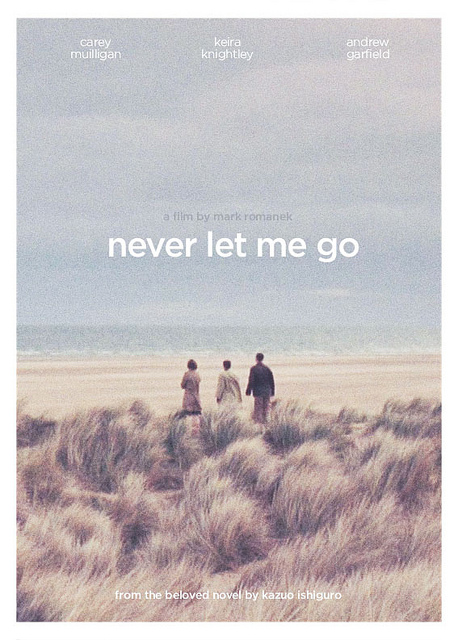
Never let me go (2010)
Based on Kazuo Ishiguro’s novel, it couldn’t be a bad film, and certainly it doesn’t disappoint. The film follows the life of a girl called Kathy H and her friends Tommy and Ruth while they all live in a British boarding school during the 70s, and also when they leave the school and go to a farm house to live in cottages during the 80s. I’m afraid that if I explain more about the plot, I’ll be spoiling the fun so you’ll have to trust me: although it may seem a bit slow, it’s worth watching. When I first saw this film I thought I was watching some sort of romantic drama… but I couldn’t be any more wrong. Give it a try!

Safety not guaranteed (2012)
This is a film I categorize as one of those “cute little films”: low budget, no special effects AND with that wonderful indie humorous touch. The film is based on a classified ad that John Silveira wrote as a joke in Backwoods Home Magazine that reads as follows:
WANTED: Somebody to go back in time with me. This is not a joke. P.O. Box 322, Oakview, CA 93022. You’ll get paid after we get back. Must bring your own weapons. Safety not guaranteed. I have only done this once before.
The film is about 3 journalists working for a magazine that are sent to find out who wrote this ad and why. It’s a beautiful little story about characters rather than time travelling itself.

Extracted (2012)
[Known as Extraction in the UK] I watched this film without knowing absolutely anything about it, and I think this is exactly how you want to watch it. It’s one of those really good films that very few people have seen because there are no important actors in it, or because the publicity campaign was tiny. If you don’t care about spoilers, proceed: Tom is a scientist who has invented a machine capable of retrieving a person’s subconscious memories. His objective is to use it in people who suffer from amnesia but he is put under pressure to accept money from an anonymous investor who wants to try the machine before it has been proven to be 100% safe. The investor happens to be an official who wants to use the machine to find if an addict called Anthony really killed his girlfriend, as suspected. When Tom enters Anthony’s mind, something goes wrong and he gets trapped there.

Snowpiercer (2013)
I love this film. In my opinion, it is the best film in this list. Snowpiercer is a South Korean film (filmed mostly in English) based on the French graphic novel Transperceneige. It stars a fantastic Chris Evans (I was gladly surprised by his interpretation), Jamie Bell, John Hurt and an unrecognisable Tilda Swinton. As with Extracted, I watched it knowing nothing about its plot, which made the experience more enjoyable and I recommend you to do the same, but if you don’t want to listen to me, read ahead: Set in a post-apocalyptic frozen planet earth, the only surviving humans live on a train called the Snowpiercer, which travels around the planet without stopping and is the only place where a human can live without freezing to death in a few seconds. The main character, Curtis Everett, lives along with other people in the tail section, the section for low-class humans. They know that the closest to the front of the train, the higher the class of the humans living in it and the better the conditions they live in; so Curtis decides to start a revolution to get to the front of the train. The beginning is intense but it gets more and more intense as the film goes on.

Oblivion (2013)
Joseph Kosinski wrote a graphic novel called Oblivion about a post-apocalyptic planet earth destroyed by aliens. It never got published so he decided to make a film. He is really good at making computer graphics and CGI, and you can tell in the film that its makers really care about making good visuals. The problem with this film is the plot. The plot is rubbish. Kosinski and his mates were too ambitious and they failed. If you are a person who goes to the cinema mainly for the visual effects, watch this film because it is visually stunning. But if you care about a good script, go watch something else. I don’t even care about explaining what the film is about.

Project Almanac (2014)
Primer + Jackass = Project Almanac. This film is produced by the MTV, and they made sure there was a lot of music in it without any logical reason why. Jonny Weston (27 when the film was shot) plays a super intelligent 15 year old boy in a high school who, along with two losers friends, builds a time machine and uses it for… everything an American teenager would use it for.
MTV hasn’t done anything good since Daria.

Edge of tomorrow (2014)
Source Code with Tom Cruise + chicken-aliens + an ending à la Jerry Bruckheimer = Edge of tomorrow. The starting idea is interesting because it is based on Hiroshi Sakurazaka’s novel All you need is kill, but since the film was “Americanised” it ended up being two hours of Tom Cruise showing off. The film is set in the future, when the earth has been invaded by aliens and human armies are fighting to survive and kill these aliens. Bill Cage is an officer, with no combat experience, who is sent to an operation and killed in combat. However, he wakes up and finds out he is in a one-day time loop. He also finds he is not the only one with this ability. Fantastic starting idea, wrongly developed.

Lucy (2014)
If you like this film, please don’t kill me just because I don’t. If you watched /will watch it because it stars Scarlett Johanson, good for you. I watched it because Luc Besson is the director and I was very disappointed. This is the idea: a woman is tricked into working as a drug-mule. She carries the drug in her abdomen but when one of her captors kicks her stomach, the drug is released and gets into her system causing her brain to use more of its capacity, developing abilities in her like telekinesis, super-strength, etc. It sounds really cool, and believe me, it is… but that ending… dear me… I don’t want to spoil you but it’s the most deceiving thing ever.

Transcendence (2014)
Christopher Nolan was the executive producer of this film, and that’s enough to make me want to see it. But… I can’t really tell what I disliked the most about this film. It has Cillian Murphy and Paul Bettany in it, which makes it good straightaway but I´m not sure whether Johnny Depp interprets or not. It seems like he was bored or he didn’t want to be there. It’s so bad, I’m not even going to explain what it is about because I don’t want you to watch it.


So these are the 10 films of the list. Have you seen any of them? What is your opinion? Do you agree with me or not? Are there any other films you want to recommend? Leave a comment.

Friday, 17 April 2015

Guessed the books?

In my last post I asked you if you could guess to what books do the quotes in the reading room in Lyme Park belong. Here are the right answers:

1) Boris Pasternak's Doctor Zhivago
2) Roald Dahl's James and the giant peach

3) Jane Austen's Pride and Prejudice

4) A.A. Milne's Winnie the Pooh
5) Emily Brontë's Wuthering Heights

Tuesday, 14 April 2015

Lyme Park: First Impressions


good adaptation
bad adaptation
I first read Jane Austen's Pride and Prejudice in 2005. I became a fan immediately and therefore, I became a hater of that same year's film adaptation - with Keira Knightley and Matthew Macfadyen-. It's a beautiful film but not well adapted. I think most people (who have read the book) would agree that the best adaptation, incredibly loyal to Austen's words, is the 1995 series with Colin Firth and Jennifer Ehle.

It is not a secret that Jane Austen was inspired by Chatsworth House to describe Pemberley, Mr. Darcy's humble flat. And though the actual Chatsworth house was used in the 2005 film and even the mini-series Death comes to Pemberley, it was not used in the 1995 series. Pemberley in that series was "played" by Lyme Hall in Lyme Park. You can watch here a little video from the 1995 adaptation, to see the locations I am talking about, and compare it to the photos you will see further on.

What did Jane see?
In the last 9 months, I have visited Lyme Park 3 times. A lover of the 19th century British literature like me cannot but walk up and down those hills, and around that astonishing manor, and put oneself in the shoes of one of those writers. I know Lyme Hall is not Jane's Pemberley, but it will do until I visit Chatsworth house.


Can you see yourself in the story?


Lyme Park is part of the National Trust.Visiting the house or the gardens (and the lake) requires paying a ticket. Prices vary depending on whether you visit only the house, only the garden or both. So far, I have visited only the gardens and that has been enough to let my imagination fly.

Yeah... I could live here.
Or even in a tent here

If you have seen the video I mentioned before, you have probably seen the lake in which supposedly Mr. Darcy likes swimming,
Mr. Darcy is there, diving.


also the gardens where Lizzy and her aunt and uncle walk,
Aren't these roses beautiful, Mr. Gardiner?

It is a truth universally acknowledged that a single man...

... in possession of a good fortune must be in want of a wife.


But Lyme Park is not only beautiful architecture, gardens, lakes, etc. They also care for us: book lovers. Next to the shop, there is a lovely little reading room. You can take any book from the shelves, sit down in one of the sofas and read for as long as you want... well, until 5pm, when they close. Some of the things I like the most from this room are the quotes on the walls. There are 5 quotes from different books. I guessed 3 out of 5. Can you guess them all without cheating?


 Give it a try! I will post the right answers in a few days.

Wednesday, 8 April 2015

The narrator in the Divergent series

This is not just another review on the Divergent saga. I have finished reading the trilogy, watched the film based on Insurgent (yes, based, because it has nothing to do with the book and it changes some of the big themes of the books), and also read the 4 short stories about/from the point of view of Four… so let me rant again about the narrator.


**BEWARE OF THE SPOILERS**

Veronica Roth

If a writer chooses to use the “easy narrator” (first person, internal monologue)- as Veronica Roth does along the whole Divergent series- this does not mean the writer will not face any problems while narrating. When giving voice to Tris, Roth finds no obstacles because, after all, she is a woman and, without coming into differences in feminine personalities, she knows what a teenage woman thinks (thus all those “He touched me! He touched me!” moments in Divergent). But she doesn’t know what a male teenager thinks. In Insurgent, the way Four phrases his thoughts in the conversations he has with Tris about their relationship, sound a bit too feminine for a man like Four. When I started reading Allegiant, I was shocked to find now we had 2 narrators: Tris and Four. My first thought was: Roth got carried away again.

Meyer did it in Breaking Dawn and it works fantastically well because 1) for some reason I won’t mention here, Bella cannot keep on narrating, she’s physically unable to do it so another character narrates; using a new narrator is completely reasonable, and 2) the difference in the narrating style is very clear which makes it easy to follow, enjoyable, and it helps you deepen in this other character’s personality and motives. Also, G.R.R. Martin changes the narrator’s point of view in every chapter of his A Song of Ice and Fire series but, unlike Roth or Meyer, he narrates in the third person, thus proving his writing and narrating skills.


Roth’s decision of using 2 narrators in Allegiant, though, was not that clever. At first, as I said, I thought Roth was just following a sort of trend because there was not a single reason why Four had to narrate certain chapters. But then, Roth did something I did not expect, something that justifies the use of 2 narrators, that to be honest, I hoped Collins had done in The Hunger Games but she didn’t and Roth was brave enough to do because it closes the whole circle of that character. Bravo, Mrs. Roth. BUT, let’s not get too excited yet. Roth uses 2 points of view, but again, she’s unable to give them different voices. There’s no way, as a reader, to tell who is narrating. Tris? Four? We know it by the context… and because at the beginning of every chapter, we are told in big letters who is the character narrating that chapter. But we cannot tell it by the style or the choice of vocabulary. Again: Four is too feminine.


When I came across this idea, I thought I was being too harsh. But then I read the introduction to the 4 short stories. Let me quote the first few lines: “I first started writing Divergent from the perspective of Tobias Eaton, a boy from Abnegation with peculiar tension with his father who longed for freedom from his faction. I reached a standstill at thirty pages because the narrator wasn’t quite right for the story I wanted to tell.” I’m glad her editor someone else thought what I thought. As I always say: write only about what you know.

Tuesday, 31 March 2015

(Old) review of The Hunger Games trilogy

This is a translation of the review I wrote on April 10th 2012 for Goodreads:


It is true that I've enjoyed this trilogy VERY MUCH (especially the 3rd part, which is curious given that most fans hate it to infinity and beyond), it is true that it's very addictive and that I've enjoyed reading it BUUUUUUUUUUUT I'm going to analyse a few details and I'll start by spitting out everything I didn't like:

Suzanne Collins
Suzanne Collins can't write. She basically has no idea.

Well, let us be a bit kinder with this poor woman: She can write; there you are a very successful trilogy and I doubt she wrote in a couple of days. But she set her own bar too high and she didn't manage to pass over it. Perhaps she allowed herself to set it higher because of the main theme of the trilogy, much higher than Mrs. Meyers’ bar when she wrote her Twilight saga. Actually, Mrs. Collins had to crawl under the bar more than once (and twice, and thrice). As a reader, you can notice her desperation some times for not knowing how to get out of that huge mess she got into by herself.
She made many mistakes of the type I'll call "the writer who reads something s/he likes and thinks: hehehe-that's-cool-I-wanna-do-that-too". My memory is not very good so I'll just mention some of the mistakes I found most shocking:


**WARNING!!! MAJOR SPOILERS AHEAD!!!**


The rule change half way through the Hunger Games. What the flip is this??? At this point of the novel, I dare to say that most female readers would marry that macho man called Gale and that, in our minds, Peeta is portrayed as a sort of naive and soft boy with no chances whatsoever. You could smell how eager Mrs. Collins was to create a love triangle with the 3 main characters. Hohoho how cool would it be to suddenly change the story to put Katniss under more pressure! BAMMM!!! And Mrs. Collins changes the rules of the game and we find out Peeta is adorable... but only when he speaks or when he has a paintbrush at hand (and that does not only happen in “The Hunger Games”, but also in “Catching Fire” and “Mockingjay”).

The 2nd rule change at the end of “Hunger Games”. You could see it coming since minute 00:00 after the new rules were introduced. To be honest, the fact that it was narrated in the present tense (something I liked very much, 10 points for that, Mrs. Collins) got me thinking during all the novel that Katniss would die in the games and that the narration of the rest of the trilogy would be taken by another character. A girl can dream.

Something I didn't like either was certain characters; characters who seem they're going to be or to do something important... but NO.

Madge: We're not friends but, hey! Yes we are! Isn't Madge lovely, bla, bla... Where is Madge? Where's the baaaaall? I would've married her to Gale in the first half of “Catching Fire”. THAT would have made the story exciting, Mrs. Collins. Resources, Mrs. Collins!!

The red-haired Avox: Who? Oh yeah!!! Half “Hunger Games” seeing her; we're going to be besties because she forgave me. Really? She told you so with that tongue she had cut, didn't she? Now I can't remember you, and in the end... dun dun duuuuun: Do you remember the Avox? Well, she died.

Darius: A sexy ginger who flirts with Katniss. He’s the reason why Gale jumps into the scene. He becomes an Avox, HER Avox, along with the other Avox. This is getting interesting. Do you remember Darius? Well, he got killed just like the other Avox.

Peeta’s parents: This is Mrs. Collins thinking what to do with Peeta’s parents: What do I do? What do I do? Uhm…. I know! They shouldn’t do anything! Dead. The end. Resources, Mrs. Collins!!

Delly: In Mockingjay she’s the only one from District 12 who can talk with Peeta during weeks. Peeta hates Katniss. Peeta is alone with Delly. Alone. HELLO?? Resources, Mrs. Collins!!

Effie Trinket

EFFIE: I don’t want to talk. You get so fond of her… she disappears at mid “Catching Fire” and you obviously think she’s been killed. But no! She wasn’t dead and appears again in the last chapter of Mockingjay… as if nothing ever happened! EXCUSE ME??????

The bow made by Beetee: A bow that only works when she touches it, that has voice recognition, that is flipping amazing, that I’m sure when in battle it has a thousand hidden gadgets… I’m sure you push a button and the A-Team appears. But… nothing. Resources, Mrs. Collins!!


On the other hand, one of the hohoho-how-cool-I-wanna-do-that-too things that many writers find very appealing is killing important characters to cause a highly tragic and emotional scene… like Cinna’s death: It’s one of the few deaths (outside the arena) that I find is very well depicted… even though we never really see him die and that makes us wait for his re-appearance at any moment at the beginning of “Mockingjay”, maybe next to Peeta (though that may be asking for too much). Besides, Cinna’s influence and presence is still there, until the very end of the trilogy. But there are two deaths that make me want to kill Mrs. Collins, both of them totally gratuitous, pointless AND after which no one sheds a single tear: Finnick and Prim.

The flipping annoying cat

Finnick’s death is extremely tragic for all the female fans because he’s a character you fall in love with and you find so sweet when Annie comes back and all that stuff and you think it’s horrible that not even Katniss or Annie show some emotions when he dies (wrong, Mrs. Collins). But Prim?? Let’s see, Mrs. Collins: Prim’s supposed to be the centre of the universe of the trilogy, everything happens because her and for her. Thus, she should be a bit more developed character. We know Prim is adorable, that everybody loves her, and so on and so forth. We know that… because we’re told so, but we NEVER get to see so. The times we get to see more of Prim is when she gets so flipping annoying because she can’t find her cat (which happens at least once in each book, and honestly, I couldn’t care less about that cat). Prim’s appearance at the end of “Mockingjay” is acceptable but, what happens when she dies? Is there a funeral or something? If so many people loved her, why the only thing we know is that Katniss goes crazy (even more), their mom never goes back to District 12, and Peeta (months later) proposes planting roses to honour Prim.

Resources, Mrs. Collins!!

What about Gale? Yeah, ok, he knows her sooooo well that he knows what she thinks just by looking at her, he anticipates her moves, he saves her more than once… but suddenly, when she’s decided to give up on Peeta (yes, yes, I know she had given up on Gale twice… it seems this girl is not very good at predicting), they kiss in the forest (you must admit it’s the best kiss of the trilogy) and… and… BAMMM!!!! The boy has a revelation and realizes that fighting for her is not worth it because she doesn’t love him. And that’s all, folks! No more Gale for you, girl. So you go crazy, your sister dies, you kill the wrong president and get locked in a room for two days, you want to kill yourself… So what? You don’t love me anymore! I better go to another district because I need a job. Personally, I don’t understand Gale.


But well, besides all this (and more details I can’t recall now), I keep grading this trilogy with the highest mark because I liked it VERY MUCH.

As I’ve already said, the fact that the 3 novels are narrated in the present tense is fantastic but I also believe my dear friend Mrs. Collins hasn’t used all her resources wisely (which by now is not very surprising given that we’ve noticed that resources are not exactly what Mrs. Collins is best at).

Another detail to highlight is the incredibly organized structure around number 3:

3 novels divided in 3 parts with 9 chapters each one (3x3). In my opinion, this is a way to remind us that although the story seems very real, it is not. It’s a built fiction (maybe built to reflect the reality we’re living in). It takes realism out, and adds premeditation.

Also, 3 are the games in which Katniss participates, yes, 3: the first ones, organised by the Capitol; the second ones, controlled by the rebels; and the third ones, the war between the Capitol and the rebels. In none of them can we say Katniss has any control over the situation but it’s curious how as her role becomes more and more important, her opinion regarding the games is taken less and less into account.

The games Coin proposes at the end with the children from the Capitol as tributes are different, but I will talk about them a bit more in the next paragraph.


I read a review a girl wrote about “Mockingjay” in which she complained about the action scenes. She was very deceived because in all of them, when Katniss is about to get on the scene, she gets knocked down, she misses everything, and we always end up knowing what happened through other people. That girl thought this was horrendous and it is true that once or twice is ok, but when you realise that is what ALWAYS happens, you can’t help agreeing with that deceived girl. In my opinion, although from the reader’s viewpoint this may seem irritating, it highlights what we already know: that Katniss has nothing under control, ever. The last thing she did because she decided so was volunteering as tribute to replace her sister. She was obliged to do all the rest: taking the role of Prim’s mom, and the father in her family; she admits that if she hadn’t had to go to the games, the logical development of her relationship with Gale would have been marrying him (not because she was in love with him and wanted to marry him but because that was the expected); also her relationship with Peeta is imposed, being the Mockingjay, her clothing, what she does at every moment is out of her control, it’s Haymitch or Effie or whoever else who decides for her; when she decides to kill herself, Peeta doesn’t let her; although she had decided not to have any children, Peeta convinces her to do the opposite… Everything, EVERYTHING is out of her control, why not the battles in “Mockingjay”? Even the games I was talking about before, the ones Coin wants to organise, those which it seems Katniss can control, or at least decide something… Obviously, history repeating, she can’t control anything at all. We’re lucky she decides to kill Coin and does so because after all, she’s the main character, isn’t she?

Another 10 points to Mrs. Collins for this: the little control Katniss has over her life.

To sum up, I think the result is quite good but the development needs to be improved: characters are not deep enough, many open stories, many irrelevant details while there are others much more important that are simply ignored. With all the money Mrs. Collins has earned from these books (and all the money she will get from the films), I suggest her to take a course on creative writing, because she’s writing novels for teenagers and that is not an excuse to not make things right.