Monday, 11 May 2015

Don't go to Barcelona. Thank you.

Les Rambles are amazing

“Where are you from?”
“Barcelona”
“Oh, I love Barcelona!”
“Have you been there?”
“Yes! I loved Les Rambles!”

I’ve had this conversation with around 100 people in my whole life, and I’m sure I will have it many more. Every time I have it, between 32 and 2975 of my brain cells die.


There's a lot to do in Barcelona in August

As a child and as a teenager I was not aware of the fact that I was from Barcelona. I went through a phase of hating the city (and I don’t mean the way all Barcelonians feel in August when there’s absolutely nothing to do there, I mean really hating Barcelona: I didn’t find any beauty in so many buildings and so much pollution). And then, after I lived away for a while and went back, I started loving Barcelona. And that love has kept growing deeper and deeper. So when people tell me they “loved Les Rambles”, they don’t understand why I want to punch them in the face straight away. The reason is because I know Barcelona, it’s mine… just as it also belongs to every other person who lives in Barcelona. We all have our own personal Barcelona.


I read an article some time ago in traveler.es called “46 things you’ll only understand if you’re from Barcelona”. It’s one of those articles with a list of funny things that I usually disagree with. I was surprised, though, that I agreed with most of the points in the list, and I actually found it hilarious. So in this post I’m going to explain some of those points (I’ve reduced it to 10) and add my opinion. If you are thinking of visiting Barcelona, this may help you understand a few more things about the city and the locals.


1. The right way of saying “bye” is “adéu”.

Forget about “adiós”, that may work in the rest of Spain (maybe not the Basque Country), but definitely not in Catalonia or its capital city, Barcelona. It doesn’t matter if you’re originally from Madrid, Sevilla, Moscow or Tokyo, if you live in Barcelona, you say “adéu”. Actually, we don’t even pronounce the “a”, we say “déu”.

2. We love complaining about tourists. 

Absolutely true. We don’t go where they are: Les Rambles, the Sagrada Familia (like most Barcelonians, I’ve never been inside. The ticket is 16€ for goodness sake!!!), or the Park Güell (I have the card that allows me to access the park for free… and I’ve never used it). It's not the tourists' fault, we know, it's actually the government's who has found a goldmine there and doesn't have any control over the hordes of tourists that invade Barcelona every day. If you are really interested in knowing more about this problem, there's an incredibly fantastic documentary called "BYE BYE BARCELONA" which explains this in more detail.


3. Walking down Les Rambles is a nightmare.

Poor tourists, they think the restaurants there serve decent food at reasonable prices. WRONG. And then they all get drunk in a second and the Rambles are full of drunk tourists vomiting everywhere and trying to find more bars where to drink more: they may go down the Rambles and end up in the port, or up the Rambles and then they invade the George Payne (a really cool Irish pub… or at least, that’s what it used to be) in Plaça Urquinaona. A tourist from New Jersey once started shouting at me there, she was drunk and I thought she was going to kill me. Then she hugged me and wanted to be my best friend. Tourists.


4. It’s easy to find your way.

Barcelona is like a square: the sea on one side, the mountains in the other, and rivers in the other two, the Besos and the Llobregat. As long as you know that, you know how to give directions and to find your way. If you don’t is because you’re not from Barcelona or you don’t have Google Maps.


5. Each neighbourhood used to be a town in the past. 
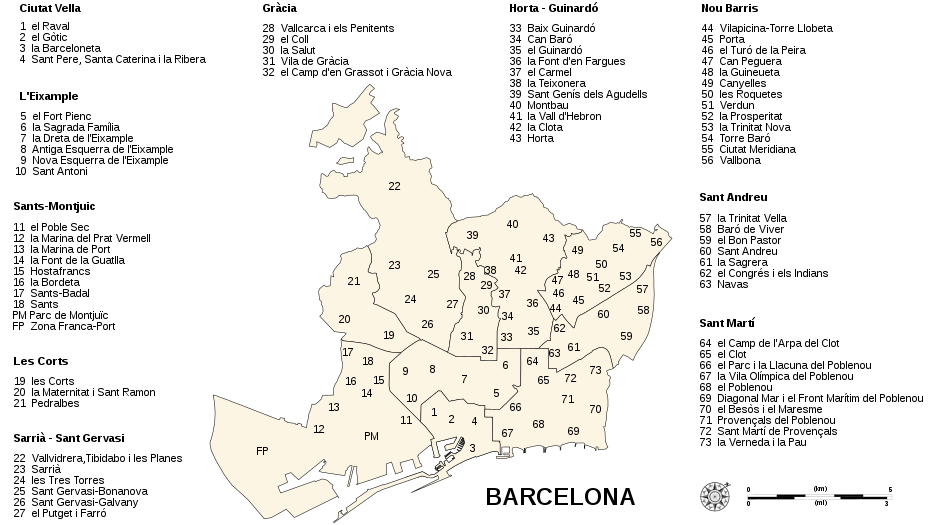
These are all the districts and neighbourhoods of Barcelona
Sants, Sarrià, Gràcia and all the others… each one is different. Different architecture, different history, the people living in them are different as well. Each neighbourhood has its own festival that usually lasts a week, with free concerts, competitions and activities for everyone. The best festival is supposed to be the one in Gràcia (around the 15th of August) but I’m probably saying so because I’m from Gràcia.


6. Of course there are beaches in Barcelona, but we don’t go there. 
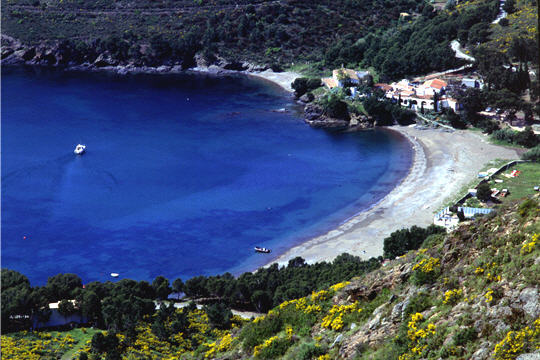
Cala Montjoi
(rocky coves in the north)

If we want to go to the beach, we go to the north or to the south, it depends on what kind of beach we like going to. The beaches in Barcelona are dirty, so we leave them to the tourists and their shadows: the thieves.
Castelldefels
(long sandy beaches in the south)

7. Barcelona is VERY humid. 

Cold feels colder and heat feels hotter because of humidity. You feel your bones wet in the winter, and in the summer… you can’t sleep. We don’t like our weather, but we feel sorry for yours anyway.


8. Food and mealtimes are SACRED. 
Shut your mouth and eat your food!

We don’t skip meals and each meal must have at least 2 courses. Lunchtime can last from 2pm to 5pm in the weekends. Dinner never happens before 9pm. Don’t be surprised at this if your dinner time is at 6 or 7pm, confess it: you are hungry again by 11pm. By the way, tapas is not a type of food, is a way of serving food. And it’s more of a way of socializing than eating. If you understand the concept of “pub-crawling”, then you understand the concept of “tapear”, it’s exactly the same but sharing food with your mates in tiny dishes. Do you know when you are in a pub and you ask the waiter to bring some peanuts? Well, that’s a tapa. Mindblowing, eh?


9. We don’t drink or take coffee, we “do” coffee.

When we want to meet up with a friend at any time before dinner, we use the expression “meet up to do a coffee”. It doesn’t matter if it’s in a café or at my/his/her house. In fact, it doesn’t matter if you really have a coffee or not.


10. We like to think we made everything first, and that what we do becomes trendy.

People in Barcelona have a sense of fashion not according to any trend but to each individual. It doesn’t really matter what you wear, as long as you do it in the right place. Each type of personality has its place in Barcelona. If you’re a goth, your street is Tallers (especially since they shut the Valhalla, a bar for rockers). If you are a skater, go to the MACBA. If your style is steampunk or Victorian goth, you’ll find a lot of people like you in Arc de Triomf, though you may also find other kinds of geeks and nerds there because the Gigamesh bookstore and the Norma Comics store are there. Bohemians and artists are in Gràcia. Hipsters go to Sant Antoni, to all these new bars and restaurants where they serve homemade beer and vermouth. Posh people are found in Bonanova and Sarrià, and chavs in El Carmel or racing with their cars in La Rabassada. The list is neverending.


I could go on and on talking about Barcelona but I’ll leave it here. If you are from Barcelona and want to add anything, feel free to post a comment. If you are not from Barcelona but you’ve been there, you’re comments are very welcome too. And if you aren’t from and haven’t been to Barcelona and want to ask or say anything, go ahead.


(All the gifs used in this post are taken from the tumblr account "When you live in Barcelona", run by a British person who has lived in Barcelona for years. Really worth having a look.)

Tuesday, 5 May 2015

"You right, love?" A linguistics nerd in Manchester

“Grammar is the greatest joy in life, don’t you find?” says Auntie Josephine in Lemony Snicket’s A Series of Unfortunate Events: The Wide Window. Grammar may not be exactly what you consider a joy. I certainly do not. But I can’t help loving phonetics and phonology with all my heart. Call me a freak.

I moved to Manchester around 10 months ago. My oral comprehension has never been very good - not even in my mother tongue -, so getting used to the Mancunian accent took me a while. Once I got used to it… or sort of, I started mentally making patterns of this accent’s features that were unusual to me. I’m sure there are lots of studies on the Mancunian accent, but here’s a list of just a few of the features I’ve personally noticed:


Intrusive /r/

10 years ago I was in my 2nd year in university and studied English phonetics and phonology for the first time. In those lessons I heard about the phonetic phenomena called linking /r/ and epenthetic or intrusive /r/.  Let me explain what these are:

In RP (RP is considered the standard variety of British English; also called the Queen’s English or BBC English), the final /r/ in words ending in vowel + /r/ is not pronounced.

e.g.:       “car” /kɑ:/
                “waiter” /’weɪtə/
                “fire” /’faɪə/

However, if these words are followed by a word beginning with a vowel, this /r/ that had disappeared is now pronounced. This is called linking /r/.

e.g.:       “car and bike” /’kɑrən’baɪk/

Notice that this linking /r/ only happens between vowels. A development of this rule is the so called epenthetic or intrusive /r/. This intrusive /r/ will appear between vowels even in cases where the first word does not have any /r/ in it.

e.g.        “law” /lɔ:/ -- “law of a country” /’lɔrəvə’kaʊntrɪ/
                “draw” /drɔ:/ -- “draw a map” /’drɔrə’mæp/

Being the Mancunian accent a British one and thus a non-rhotic one, I expected to hear this linking /r/ all the time. And I did. But what I did not know is that I was going to hear the intrusive /r/ as well… even in the middle of words (which means that this rule applies not only to word endings but to any open syllabic codas) and in isolated words (which… is absolutely crazy)!!!

e.g.:       “drawing” -- RP /’drɔ:wɪŋ/ vs Manchester /’drɔ:rɪŋ/
                “idea” -- RP /ʌɪ’di:ə/ vs Manchester /ʌɪ’di:ər/


Final velar nasal /ŋ/

I was an EFL teacher in Spain for some years and, as I’m sure you’ve already noticed, for me, right pronunciation has always been a matter of concern. One of the hardest things for Spanish students is correctly pronouncing the final velar nasal, as they assume the <g> must be pronounced. They either add a velar plosive (usually a voiceless one as in Spanish there is no final voiced velar plosive) or they change the velar nasal for an alveolar nasal.

e.g.:       “eating”          RP /’i:tɪŋ/
                                               Spanish students      Option 1: /’itiŋk/
                                                                                              Option 2: /’itin/

But then I arrived to Manchester and my world was turn upside down:

RP <ng>  [ŋ] / __#
Manchester <ng>  [g˳] /__ #

So to make Spanish students happy, here the <g> is pronounced and actually, it’s slightly devoiced. “Eating” would be pronounced as /’i:tɪŋg˳/


/u:/ fronting

I’ve noticed that in some words with what in RP would be the /u:/ sound, here is pronounced /y:/. It’s like a 21st century Vowel Umlaut. I’ve heard it in final position in monosyllabic words (e.g.: “poo” - RP /pu:/ vs Manchester /py:/) but I’m still trying to figure out if this is the only condition in which this fronting occurs.


Glottal fricative dropping

For some reason, in most cases, Mancunians drop the glottal fricative when it’s at the beginning of a syllable, and especially if this syllable is unstressed.

RP [h] vs  Manchester Ø / #__Vͯ

e.g.: “tell him” [‘telɪm]

When I think of how the names of certain places in England are pronounced, I assume the glottal fricative dropping is an extended feature.

                e.g.:       “Buckingham” /’bʌkɪŋəm/
                               “Dunham” /’dʊnəm/
                               “Birmingham” /’bɜ:mɪŋəm/

I realise these 3 examples I’ve given contain the same ending ( <-ham> ) which derives from the Anglo-Saxon word “ham” meaning "settlement", so maybe my theory that the glottal fricative dropping is a widespread feature is completely wrong.


Last but not least, I’d like to mention one of my favourite cases. It’s a mix of the first and the fourth features listed: intrusive /r/ and glottal fricative dropping.

It’s the way the phrase “saw her” is pronounced. The /h/ in “her” disappears, which results in a diphthong. This diphthong is then broken by introducing /r/.

                RP [‘sɔ:hə]
                Manchester [‘sɔ:ɽə]


Absolutely lovely, don’t you find?


Friday, 17 April 2015

Guessed the books?

In my last post I asked you if you could guess to what books do the quotes in the reading room in Lyme Park belong. Here are the right answers:

1) Boris Pasternak's Doctor Zhivago
2) Roald Dahl's James and the giant peach

3) Jane Austen's Pride and Prejudice

4) A.A. Milne's Winnie the Pooh
5) Emily Brontë's Wuthering Heights

Tuesday, 14 April 2015

Lyme Park: First Impressions


good adaptation
bad adaptation
I first read Jane Austen's Pride and Prejudice in 2005. I became a fan immediately and therefore, I became a hater of that same year's film adaptation - with Keira Knightley and Matthew Macfadyen-. It's a beautiful film but not well adapted. I think most people (who have read the book) would agree that the best adaptation, incredibly loyal to Austen's words, is the 1995 series with Colin Firth and Jennifer Ehle.

It is not a secret that Jane Austen was inspired by Chatsworth House to describe Pemberley, Mr. Darcy's humble flat. And though the actual Chatsworth house was used in the 2005 film and even the mini-series Death comes to Pemberley, it was not used in the 1995 series. Pemberley in that series was "played" by Lyme Hall in Lyme Park. You can watch here a little video from the 1995 adaptation, to see the locations I am talking about, and compare it to the photos you will see further on.

What did Jane see?
In the last 9 months, I have visited Lyme Park 3 times. A lover of the 19th century British literature like me cannot but walk up and down those hills, and around that astonishing manor, and put oneself in the shoes of one of those writers. I know Lyme Hall is not Jane's Pemberley, but it will do until I visit Chatsworth house.


Can you see yourself in the story?


Lyme Park is part of the National Trust.Visiting the house or the gardens (and the lake) requires paying a ticket. Prices vary depending on whether you visit only the house, only the garden or both. So far, I have visited only the gardens and that has been enough to let my imagination fly.

Yeah... I could live here.
Or even in a tent here

If you have seen the video I mentioned before, you have probably seen the lake in which supposedly Mr. Darcy likes swimming,
Mr. Darcy is there, diving.


also the gardens where Lizzy and her aunt and uncle walk,
Aren't these roses beautiful, Mr. Gardiner?

It is a truth universally acknowledged that a single man...

... in possession of a good fortune must be in want of a wife.


But Lyme Park is not only beautiful architecture, gardens, lakes, etc. They also care for us: book lovers. Next to the shop, there is a lovely little reading room. You can take any book from the shelves, sit down in one of the sofas and read for as long as you want... well, until 5pm, when they close. Some of the things I like the most from this room are the quotes on the walls. There are 5 quotes from different books. I guessed 3 out of 5. Can you guess them all without cheating?


 Give it a try! I will post the right answers in a few days.

Wednesday, 8 April 2015

The narrator in the Divergent series

This is not just another review on the Divergent saga. I have finished reading the trilogy, watched the film based on Insurgent (yes, based, because it has nothing to do with the book and it changes some of the big themes of the books), and also read the 4 short stories about/from the point of view of Four… so let me rant again about the narrator.


**BEWARE OF THE SPOILERS**

Veronica Roth

If a writer chooses to use the “easy narrator” (first person, internal monologue)- as Veronica Roth does along the whole Divergent series- this does not mean the writer will not face any problems while narrating. When giving voice to Tris, Roth finds no obstacles because, after all, she is a woman and, without coming into differences in feminine personalities, she knows what a teenage woman thinks (thus all those “He touched me! He touched me!” moments in Divergent). But she doesn’t know what a male teenager thinks. In Insurgent, the way Four phrases his thoughts in the conversations he has with Tris about their relationship, sound a bit too feminine for a man like Four. When I started reading Allegiant, I was shocked to find now we had 2 narrators: Tris and Four. My first thought was: Roth got carried away again.

Meyer did it in Breaking Dawn and it works fantastically well because 1) for some reason I won’t mention here, Bella cannot keep on narrating, she’s physically unable to do it so another character narrates; using a new narrator is completely reasonable, and 2) the difference in the narrating style is very clear which makes it easy to follow, enjoyable, and it helps you deepen in this other character’s personality and motives. Also, G.R.R. Martin changes the narrator’s point of view in every chapter of his A Song of Ice and Fire series but, unlike Roth or Meyer, he narrates in the third person, thus proving his writing and narrating skills.


Roth’s decision of using 2 narrators in Allegiant, though, was not that clever. At first, as I said, I thought Roth was just following a sort of trend because there was not a single reason why Four had to narrate certain chapters. But then, Roth did something I did not expect, something that justifies the use of 2 narrators, that to be honest, I hoped Collins had done in The Hunger Games but she didn’t and Roth was brave enough to do because it closes the whole circle of that character. Bravo, Mrs. Roth. BUT, let’s not get too excited yet. Roth uses 2 points of view, but again, she’s unable to give them different voices. There’s no way, as a reader, to tell who is narrating. Tris? Four? We know it by the context… and because at the beginning of every chapter, we are told in big letters who is the character narrating that chapter. But we cannot tell it by the style or the choice of vocabulary. Again: Four is too feminine.


When I came across this idea, I thought I was being too harsh. But then I read the introduction to the 4 short stories. Let me quote the first few lines: “I first started writing Divergent from the perspective of Tobias Eaton, a boy from Abnegation with peculiar tension with his father who longed for freedom from his faction. I reached a standstill at thirty pages because the narrator wasn’t quite right for the story I wanted to tell.” I’m glad her editor someone else thought what I thought. As I always say: write only about what you know.